Vinyl Plank Flooring Clicking When You Walk on It? Here’s the Likely Fix
Vinyl plank flooring clicking underfoot is typically a sign of movement between planks, between the flooring and the subfloor, or both. The sound occurs when planks shift slightly with each step, causing the locking joints to rub or flex. Identifying the source of the click usually determines how involved the repair will be.
The approach varies depending on whether the floor is floating, glued down, or nailed, and whether the issue is localized to one area or spread across the room. A floating floor that lacks expansion gaps will behave differently than one sitting on an uneven subfloor. Conditions like humidity changes, subfloor irregularities, and improper installation all affect which fix applies.
This article covers how to diagnose the clicking, what tools and materials are needed, and step-by-step instructions for the repairs that address the underlying causes — including subfloor leveling, expansion gap correction, and plank re-engagement.
Some steps in this repair involve power tools and sharp blades. Wear safety glasses throughout. Keep hands clear of cutting paths. Turn off any power tools before changing blades or adjusting settings.
Tools and Materials
Tools
- Knee pads
- Flat pry bar
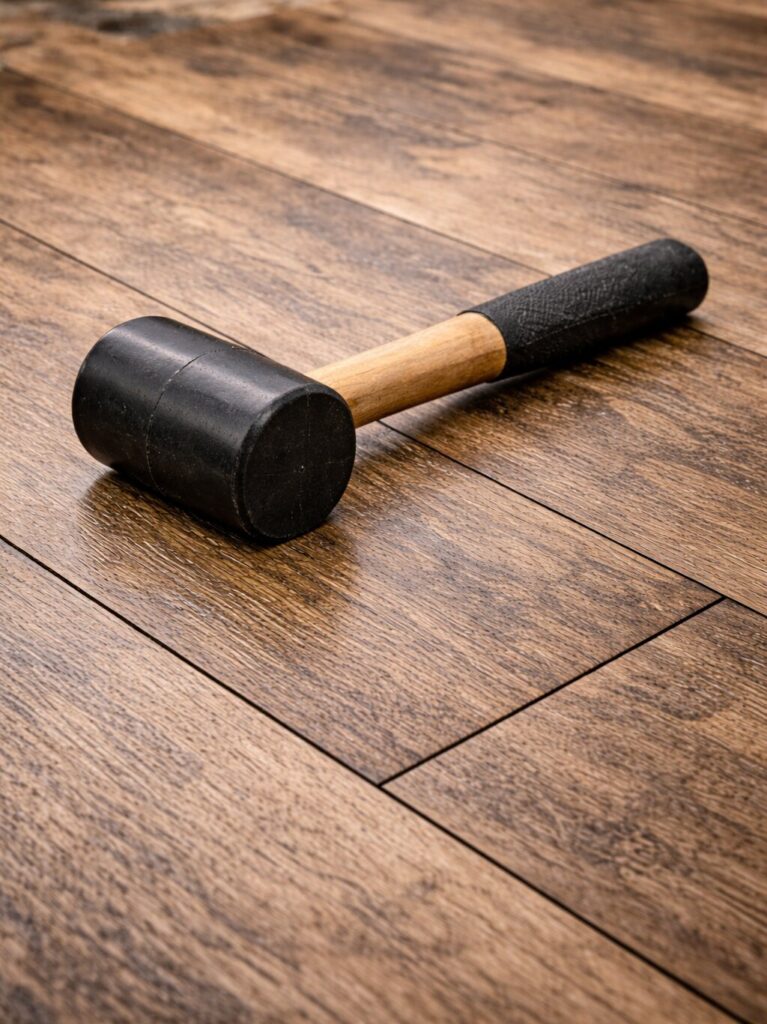
- Rubber mallet
- Tapping block
- jigsaw
- Pull bar
- Straight edge or level (6-ft preferred)
- Utility knife
- Pencil
Materials
- Underlayment (if missing or damaged)
- Self-leveling compound
- Replacement planks (same SKU or closest match)
- Spacers (for expansion gap correction)
Optional
- Floor adhesive (for spot-gluing loose planks)
- Moisture barrier tape
Diagnosing and Fixing Vinyl Plank Flooring Clicking
Clicking in vinyl plank flooring tends to fall into three categories: subfloor irregularities, missing or closed expansion gaps, and disengaged locking joints. Walking the floor slowly and pressing down in the affected areas can help narrow the cause before any planks are removed.
Uneven Subfloor Causing Flex and Noise
This applies when the clicking is spread across a wider area, or when you can feel the floor flex slightly as you step. A subfloor that dips or crowns more than 3/16 inch over 10 feet allows planks to rock, which produces clicking at the joints.
You will need: 6-ft level or straight edge, self-leveling compound, mixing bucket, trowel, floor scraper
- Pull back the affected planks carefully using a pry bar, working from the nearest wall.
- Lay a straight edge across the subfloor in multiple directions to locate high and low spots.
- Sand or grind down high spots using a floor grinder or belt sander.
- Mix and apply self-leveling compound to low spots following the manufacturer’s instructions. Allow full cure time before proceeding — typically 24 hours, but check the product label.
- Re-lay the underlayment if it was disturbed.
- Re-click the planks back into place using a tapping block and rubber mallet.
If the subfloor is OSB or plywood with loose fasteners, re-screw or nail those areas before applying leveling compound.
Expansion Gap Closed Off or Missing
This applies when clicking occurs near walls, transitions, or fixed objects like cabinetry. Vinyl plank flooring expands and contracts with temperature changes. If no expansion gap was left during installation — or if the gap has been closed off by baseboards installed too tightly — the floor has nowhere to move and planks begin buckling or rubbing at the joints.
You will need: Pry bar, spacers, oscillating tool or jigsaw, replacement baseboard or quarter round
- Remove baseboards along the affected wall using a flat pry bar. Work slowly to avoid splitting the trim.
- Check the gap between the last plank row and the wall. A 1/4-inch gap is standard for vinyl plank; some manufacturers specify 3/8 inch — check your product documentation.
- If no gap exists, use a jigsaw or oscillating tool to cut back the plank edge. Work carefully to avoid cutting into the subfloor.
- Insert spacers along the wall to hold the gap while reinstalling trim.
- Re-nail or re-glue baseboards, making sure they sit on top of the plank surface — not pinning it down.
- Walk the floor to confirm the clicking has reduced.
If the gap exists but trim was glued directly to the plank surface, carefully score and release the adhesive with a utility knife.
Disengaged or Damaged Locking Joints
This applies when clicking is isolated to a small section and the floor does not flex noticeably underfoot. Locking joints in floating vinyl plank can disengage if planks were improperly installed, if the subfloor shifted, or if a heavy impact separated the joint.
You will need: Pull bar, tapping block, rubber mallet, replacement planks (if damaged)
- Identify the affected plank or planks by pressing down at each joint edge to locate where movement occurs.
- Work from the nearest wall to the affected row, removing planks one row at a time.
- Inspect the locking edge of the disengaged plank for damage. Chipped or deformed edges will not re-engage reliably.
- If the lock is intact, re-click the plank by angling the tongue edge into the adjacent groove at roughly 20–25 degrees and pressing down firmly until you hear or feel the click.
- Use a tapping block and rubber mallet to seat the joint fully. Do not strike the plank directly — this can crack the locking profile.
- Replace any planks with damaged edges rather than attempting to re-use them.
- Re-lay planks back toward the wall and replace baseboards.
When the Clicking Returns After a Fix
If clicking resumes within a few weeks, the subfloor is the more likely cause. A subfloor that flexes due to joist spacing, moisture damage, or inadequate thickness will continue to allow plank movement regardless of how well the surface layer is installed.
- Check joist spacing: 16 inches on center is standard for 3/4-inch plywood subfloors.
- Check for moisture: Use a moisture meter on the subfloor before re-installing vinyl plank. Most manufacturers specify subfloor moisture content below 14%.
- Check subfloor thickness: Vinyl plank over subfloor thinner than 3/4 inch may flex enough to cause ongoing joint noise.
If the subfloor needs structural repair, that work should be completed before any flooring is re-installed.